
I’ve just returned from Philadelphia where I attended this years I AM PHENOM user conference. This year it had about 2,500 customers and prospects gathered together at the convention center downtown.
Phenom uses this event (which also happens in Europe & India) as lead gen, brand awareness and education for their current customers and prospects. A small number of vendors also are invited with the majority of them being integration partners and recruitment ad agencies.
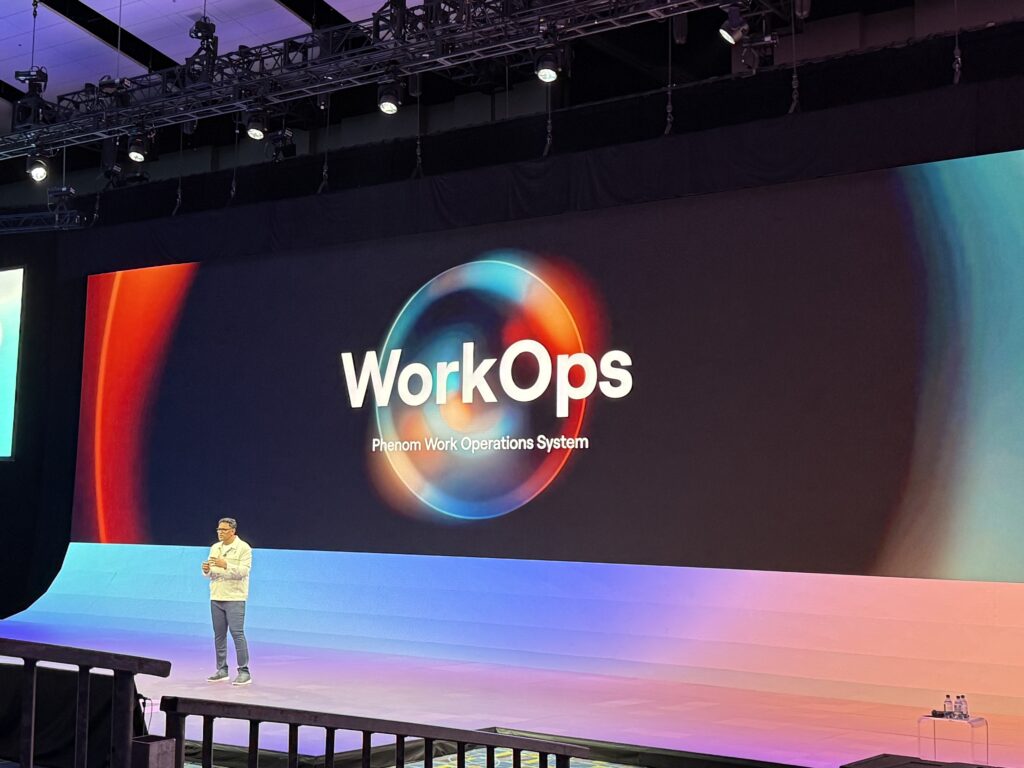
Unlike last year when they debuted 25 AI agents, this year saw no major product announcements rather they focused on product enhancements particularly around workflows and data orchestration. They called it WorkOps and you can read more about it down below. They also announced a move into Public Sector HR which I’ll get to.
I did see a big focus on their voice screening agent (for high volume) and they had a number of customer stories around the success of that feature. One airline customer for example saw 93% of interviews scheduled without human intervention…overall they’re AI screening increased interviews scheduled by 107% in 2025. Impressive.
Phenom expects to achieve FedRAMP ready status in the next few months, which will allow them to move into the public sector at the federal, state and local levels. This is an ambitious move by the company but it has massive opportunity as well. Their corp dev lead Morgan Onopa gave us some insight and their plan is to tweak the Phenom platform to serve federal and state agencies which are traditionally lacking effective talent/workforce software.
This will be a tough market to crack because the sales cycles in this sector are very long and complicated. But the TAM (total addressable market) is what attracts Phenom. They say the U.S. TAM alone is $8 Billion, $15-17B for international markets.
In their quest to help a ‘billion people find the right job’, going after this market is probably necessary to get them there.
ANALYST DAY NOTES
2026 Theme: “applied AI”, HR’s new AI infrastructure, responsible Ai…work ops. Light product enhancement to help HR orchestrate workflows.
MAHE BAYIREDDI, CEO Q&A
- Mahe CEO thinks every category is collapsing, traditional SAAS is dying slowly
- Therefore Phenom is trying to become so important to the enterprise it is needed
- We are ‘Applied AI company focused on HR’
- Acquisition strategy: more about product velocity…based on where they want to expand…to make the prod more valuable…
- Worried about hiring environment/recession?: diff industries are up and down, they need to adjust …plow thru as best they can…
- Customer lifetime value is growing because they are delivering more to them…
- Biggest challenges: tech is changing fast, how to deliver roi qtr over qtr
- Agents in use? Still early for that for the most part
- Workday getting more into recruitment…worried? Confident with Phenoms prod vs Paradox…competition is good
- Pricing will stay fixed because HR can’t handle consumption based pricing (AI)
Having covered Phenom since the early days I think their platform is at the forefront of hiring software features with all the AI and automation being built. They are constantly looking forward and trying to stay one step ahead of competition.
OFFICIAL ANNOUNCEMENTS
Phenom’s layered AI infrastructure makes it possible to deploy intelligence and agents where they matter most (across markets, geographies, labor environments and workforce models) without the risk and overhead of building and maintaining custom solutions.
- Engines, the power layer: The core that powers AI-driven talent operations at enterprise scale
- Ontologies, the intelligence layer: A living map of how work, skills, and people connect across the enterprise, built on three dimensions: strategy that guides the flow of intelligence, structure that engineers how work gets done, and culture that defines purpose
- X AI, the shared capability layer: Flexible intelligence that organizations can trust and act on
- Experiences, the interaction layer: Purposely designed experiences that embed AI into every talent interaction
- Use Cases, the application layer: Nuanced AI applications tailored to real workforce challenges
- Agents, the execution layer: AI agents working alongside teams to execute talent operations from hire to retire
Together, these layers form the building blocks of Phenom WorkOps, giving HR the intelligence to understand every dimension of their workforce and act on it. What distinguishes this approach is that core capabilities are decoupled from specific use cases, so intelligence can be applied uniquely across every workforce scenario. Rather than building isolated products, Phenom’s agents draw from the same underlying infrastructure, reaching the right moment in the talent lifecycle without rebuilding for each new challenge. All agents inherit the ontology, policies, and orchestration logic they need to adapt to the industry, function, role, workflow, geography, hiring urgency and cultural context of every organization.
For example, the same voice capability that powers a screening agent also drives an intake agent, scheduling agent and exit interview agent (each configured to the specific conversation it needs to have). The same compliance guardrails applied to a job posting agent extend to onboarding; and the same adaptive assessments used by an interviewer agent are deployed by a skills validation agent.
In practice, Phenom Voice Intake Agent handles conversations about new job openings over the phone, letting a hiring manager talk through the role, shift requirements, specialization and start date. The agent parses the conversation, generates the job description and routes relevant documents to Phenom Compliance Agent for local regulation review, all before the hiring manager has finished the call.
The Hypercell Operating Model Applied for HR
General automation is a liability. When hiring conditions change (e.g., sudden talent shortage, candidate application surge, regulatory shifts), legacy technology systems can’t keep up. They apply the same rigid workflow regardless of the business context, forcing companies back into manual processes. To support the unique hiring, development and retention strategies across markets, enterprises require technology that can adapt quickly.
Phenom’s Hypercell operating model for HR reimagines how work gets done with AI, bringing context to support every situation. Borrowed from systems thinking and modular architecture, a hypercell is a self-contained, intelligent unit that can make its own decisions while still operating as part of a larger system. For HR, the intersection of each role, market and moment requires its own tailored strategy rather than being forced into a generic workflow. Individual hypercells respond to local conditions autonomously, while the broader system stays coordinated, giving organizations the flexibility of distributed decision-making without sacrificing enterprise-wide consistency.
Phenom Orchestration Engine: Oversees and Governs AI Agents in Real Time
Most automation tools are rigid and break when exceptions occur: hiring managers miss interviews, candidates fail late-stage checks or recruiting teams face sudden workload shifts. These aren’t edge cases; they’re the everyday reality of talent operations at scale.
Phenom Orchestration Engine oversees and governs AI agents, enforces policies, and notifies when human intervention is required in real time. Organizations are supported by:
- Guardrail and routing policy creation, giving leaders conversational control over the parameters of AI agent execution.
- Decision tracking that logs every agent action and case that has been escalated for human review, ensuring AI agent execution is auditable and fully explainable.
- Compliance Agent, reviewing every job description against state, federal, and local regulations, as well as internal equity policies.
Eliminating Fraud and Synthetic Candidates
As generative AI makes it easier than ever to fabricate credentials, spoof identities, and script real-time interview responses, hiring fraud has evolved from isolated incidents into coordinated, multi-layered attacks designed to be invisible to human interviewers.
Phenom enables organizations to address this through advanced fraud protection and real-time manager visibility, which includes a continuous, multi-step validation process that checks identity authenticity and integrity throughout the hiring process. Organizations are empowered to ensure hiring decisions reflect genuine candidates, not synthetic or AI-generated illusions, when supported by:
- Cognitive Assessments, deploying adaptive, science-based evaluations at the point of application.
- AI Interviewer, conducting autonomous interviews that evaluate skill gaps, manager requirements, and competencies defined in the job description. When responses are too generic, it probes deeper before a human enters the process.
- Meeting Assistant, surfacing candidate details during live, human-led interviews, identifying competency gaps to guide conversations, and flagging behavioral concerns in real time.
- Integrity Insights, running in the background to identify AI-generated response patterns, real-time scripting signals, and coordinated candidate fraud networks.
- Decision Engine, surfacing a decision brief for each candidate who reaches the final stage, synthesizing assessment performance, interview competency scores, integrity signals, and skills.
- Hiring Manager Dashboards, providing real-time visibility into every agent action on a manager’s behalf, including voice call transcripts, candidate rankings with behavioral and assessment scores, shift preference data, and policy compliance status. Managers can step in, send a follow-up, or override a next action at any point, without switching systems.
AI-led Workforce Redesign Closes The Gap Between Strategy And Execution
The pressure to adopt AI is enterprise-wide, but the intelligence required to act on it is fragmented. Workforce data sits in disconnected systems; critical questions about skills, capacity, and performance go unanswered. Phenom closes that gap by turning scattered data into actionable insight, while developing task-level plans for reskilling, automation and agent deployment.
As organizations increasingly require employees to integrate AI into their daily work, HR and business leaders lack the task-level intelligence to know where to apply it. Phenom Work Redesign addresses this by identifying existing skills and gaps within the workforce, and recommending opportunities for reskilling talent or deploying AI to accelerate performance. It uses X+ Task Ontology to connect the way work actually gets done in the organization across roles, tasks, skills, competencies, and proficiencies. Global enterprises are empowered to get ahead of shifting markets, and focus on strategic decision-making, when supported by:
- Chief of Staff Agent, providing people managers with task-level role analysis, automation scoring, and task-by-task evolution plans.
- Skills Validation Agent, verifying employee skills in minutes through adaptive voice or video tests and assessments.
- Success Coach Agent, guiding new hires through the onboarding experience from their first day, building employee profiles and mapping skills to the enterprise ontology automatically, and assembling a personalized onboarding journey.
- Workforce Strategy Dashboard, enhancing workforce planning for strategic directives, showing the initiative’s progress across teams in real time and identifying which tasks can be automated, which require human input, and what requires a unified approach.
X+ Talent Advisor Turns Workforce Data into Action
Business and HR leaders have more data than ever and fewer answers: metrics sprawl across disconnected systems, critical questions go unanswered and teams spend weeks building reports instead of driving strategy.
Phenom X+ Talent Advisor enables organizations to take action based on data and mobilize talent plans in seconds. At the foundation is an architecture built for enterprise data complexity, including a flexible canonical model and data quality engine that auto-corrects errors, closes inactive requisitions and merges duplicate records. Executives and HR leaders asking simple questions, such as why time to fill is increasing, can get the clarity they need to take action. Talent Advisor provides empower leaders at all levels with:
- Data and context around what’s happening, what it means and recommendations to take action.
- Auto-generated executive narratives that synthesize thousands of metrics into clear, commentary-driven stories so leaders can focus on presenting strategy.
AI-Enhanced Service Delivery Models: Outcomes in Weeks, Not Months
Traditional SaaS implementations celebrate implementation as the finish line, but for most organizations, that’s exactly where momentum stalls. Phenom’s Value Acceleration Model and AI Bootcamps replace the old model with a new standard that provides the ability to deploy AI quickly and continuously as needs evolve, ensuring customers demonstrate value and outcomes in weeks. Together, customers can redefine success based on long-term value and operational transformation:
- The Value Acceleration Model embraces a partnership model that pairs customers with dedicated Phenom solution architects to align AI deployment with clear business objectives, establish milestone-based deployment paths with outcomes at every stage, and provide continuous post-launch optimization. Workforce analytics create a baseline understanding of the customer to expedite the implementation process by aligning the context of the company with preconfigured industry best practices.
- AI Bootcamps compress the learning curve through immersive programs that build internal AI fluency across HR, IT and talent teams, equipping organizations to run, retrain and redirect AI-driven hiring and retention strategies independently. Bootcamps use process intelligence to identify critical roles and workflow blockers to rapidly deploy agents in a few weeks.
Responsible AI: 2026 Bias Audit and Compliance Updates
Phenom follows a risk-based approach to map, measure and manage AI concerns across development and deployment. Its annual independent bias audit recently revealed no evidence of algorithmic bias in the Phenom model with respect to race, ethnicity or their intersection.
Phenom also announced its first conformity assessment under the EU AI Act and updated governance guidance on the use of biometric data in its Fraud Agent. The governance model now incorporates the NIST AI Risk Management Framework and the most recently published OECD Guidance. A Responsible Deployment Guide for the Voice Agent provides customers with scoring rubric guidance, algorithmic audit support and risk mitigation resources for various use cases.
